The Accidental Remodeler, Part II: Are you ever really done?

Based on comments to my recent blog, it became apparent to me that the frustrations, cost overruns, contractor issues, etc. that I have experienced on my porch addition are certainly not unique. In fact, it made me feel a little better to know that so many of you have shared my pain. But that’s what friends are for, right?

What also became apparent to me, though, is that I am no accidental remodeler. If anything, I am a chronic remodeler, not only of my dwelling, but of the “stuff” of my life.

It became somewhat of a running joke in the first 35 years of my married life as to why I always had to “change my things.” Changing my things meant new dishes, new bedding, upgraded furniture, nicer jewelry — every few years. As I told my late husband, he shouldn’t worry that I “changed my things,” because I kept him. So best to keep quiet about the stuff of life.

Yet even in our first house of substance on Eagle Mountain Lake in Azle, TX, we expanded the master bedroom by taking in some attic space to create a small sitting area. That gave me room for a wingback chair, an ottoman, and a television set. That’s where I spent the wee hours of the first six months of Zack’s life nursing him during the night. We also upgraded the master bath, by sinking the tub, adding jets, and installing a skylight.

Nor did we stop there. We enclosed half of the back deck, which overlooked the lake, to create a sun porch. If memory serves me well, we failed to expand the central air-conditioning system, because I distinctly remember candles melting in that room from the heat. That room was not one of our remodeling success stories.

But the remodeling bug struck in the early 1980s.

After nine years in that house and wonderful neighborhood (still close friends with two couples from that neighborhood), we moved to a grander home in South Arlington. It was brand new and much larger, so needed no expansion, only a dash of color.

So we attempted to brighten the walls with paint. The taupe in the living room became lavender (I am not a purple person). The salmon in the bedroom became Pepto-Bismol pink. Nothing we did was quite right in that house, except for the border a friend and I installed in the boys’ bedroom: high-top sneakers with reflective soles.

The best thing we could do to correct the mistakes in that house was to sell, which we did some years later. My understanding is that the new owners painted over our mistakes immediately. Good for them!

Seems to me there were no major remodeling projects for the next four years that we lived in Cedar Hill, south of Dallas. It was a great house until the moment we knew the East Coast was calling us home.

We landed in Connecticut in 2001, moving into a center hall colonial built in 1985 (or thereabouts). It was dated in many ways and marked the start of my serious, serial remodeling. We moved kitchen cabinets, installed granite countertops, remodeled bathrooms, expanded the hardwoods, finished the basement. No room was left untouched.

And by and large, no project was a disaster. With age, comes wisdom and money. You hire better help and hopefully develop better taste.

But there was a distinct moment in time when I recognized the intrinsic value of remodeling, and it had nothing to do with increasing the value of one’s home or property. It had everything to do with one’s mental health.

In 1990, when we were in the South Arlington house, my father passed away. Though he had been diagnosed with lung cancer, the result of a lifetime of smoking, his death came suddenly and unexpectedly on Thanksgiving Day. My parents were inseparable, having been married for 49 years. Not only were they life partners, they were work partners, and my mother depended on my father for handling the affairs of their lives. My brothers and I feared for my mother — and she proved us wrong.

Our house, the only house I had ever lived in, had a strong masculine touch to it. Maybe it was the orange shag carpet in the living room. Or the exposed beams. Or the large stone bar my father had installed after he enclosed the back porch.

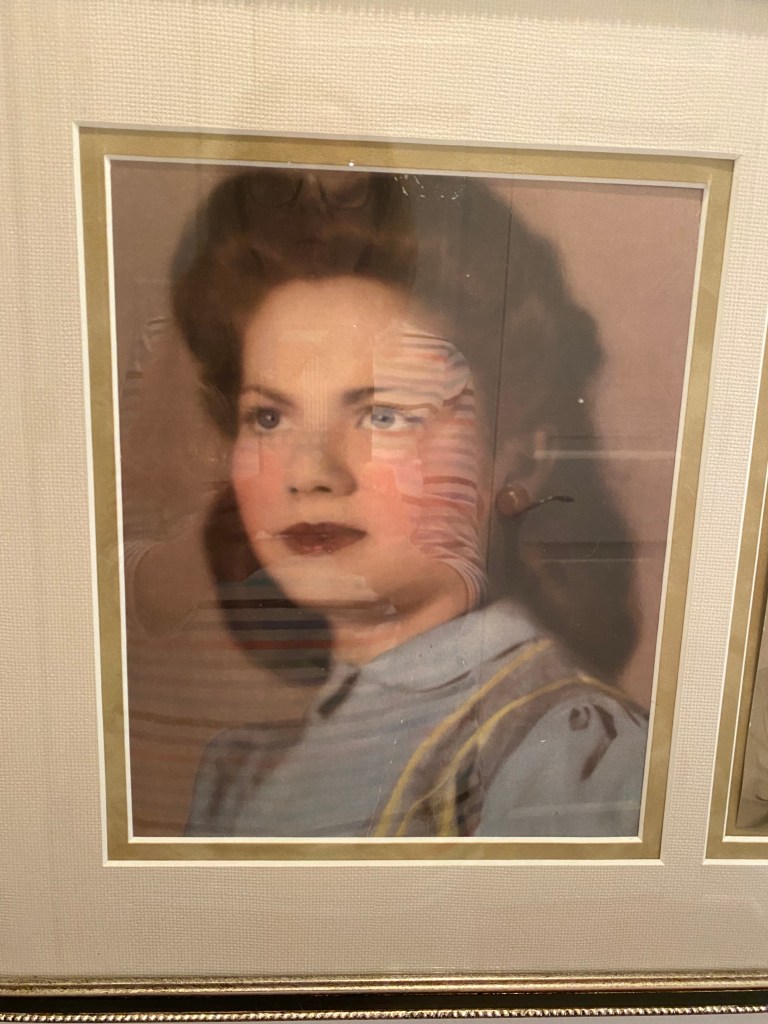
Mom set out to make the house her own. We watched as she packed each piece of china and every pot and pan (some she never unpacked!), had that ugly shag carpet pulled, took those beams down. Her house became girly to the nth degree.

Her walls became pink, and she didn’t seem to mind the Pepto-Bismol tones. If I remember correctly, her sofas were floral. Everything was floral. You never saw so much pink and green in your life. And whether you liked it or not, the process transformed my mother.

For months, the remodeling energized her. It gave her exercise, both physically and mentally. It allowed her to make decisions that she could enjoy and live with. Simply put, the process empowered her.

And I keenly witnessed that. The moment that I was suddenly widowed in 2013, I made a list of projects; the first projects were done out of fear. First, I installed lights up and down the long, dark driveway and doubled the flood lights all around the house. The house sat on 2.3 acres, so it was more important than ever that the house and property be as bright as possible. It became less important to me after that first electric bill came in. Suddenly, I was less scared.

I installed a chandelier in the bedroom, because I needed lightness in every room. Dark, heavy furniture gave way to brighter, colorful pieces (I was on a first-name basis at Ethan Allen), at the advice of my sister-in-law, who wisely said that every room “needs happy.” That remains my decorating mantra to this day (so I hope you like the orange coffee table in the living room, which was bought at that time).

And as the story goes, my brother and sisters-in-law finally convinced me to come home to Charleston, where I purchased a home built in 1989. It was beautifully decorated, but not to my taste, so I have spent the past five years moving from project to project. Big projects.

I have fully schooled Allan in my philosophy of “changing stuff,” but he knows I will keep him so no need to worry. He needn’t worry about my chronic need to constantly update, and in my opinion, improve my environment. What he sees as his lottery home is, in my eyes, a constant work in progress.

You heard the details of the porch project. Nothing has progressed since my last post — the sprinkler system is still not operative and the gas logs are not in the fireplace. But since we are having record-breaking heat waves, I am not too worried about those logs.

Should you be wondering, I have a list of pending projects, both small and large. I am waiting on a bid for installing some additional stair rails, two short rails into the living room and a longer banister into the FROG (finished room over the garage, our family room). Then comes the contemporary glass barn door for the laundry room.

And next year, should the market rebound and our health remain good, we will tackle the master bath and closet. That over-sized 1980s garden tub is crying to be removed and our master closet MUST be enlarged.

So I confess. I am no accidental remodeler. I am a serial remodeler. I am an avowed nester, and love improving my surroundings in small and big ways (I love art, area rugs, lamps, etc.).

Perhaps most of all, making these decisions helps me feel alive. Keeps me on top of trends and styles (most of which I ignore). There are few things in the world I can control, but I can control my own home environment. And at least in my own mind, that knowledge and the subsequent actions help me feel empowered.

The Accidental Remodeler

Or Maybe Not an Accident at all …

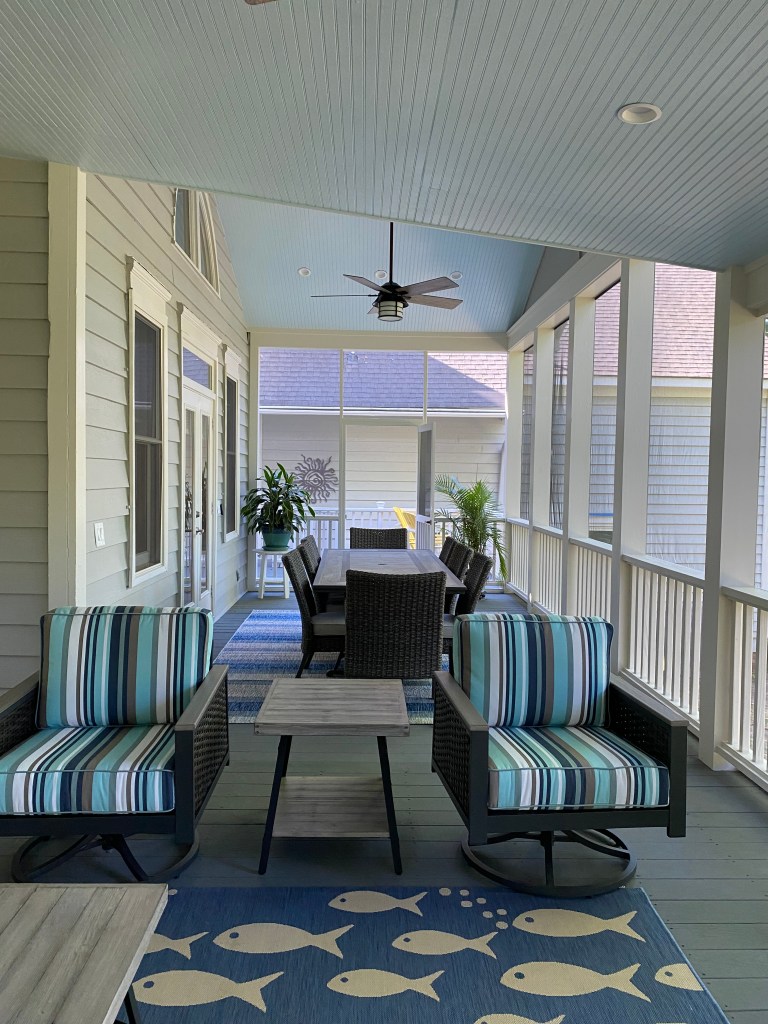
This post has been on my mind since January of this year, when I launched a long-awaited outdoor addition to the house. It involved removal of the back deck, expanding it across the width of the entire back of the house, roofing it, wiring it (recessed lights and ceiling fans), and screening it. The end result was to be an outdoor living room and dining room, allowing my husband and I to enjoy our beautiful lake view year-round, despite summer heat, mosquitos, or the winter chill.

It was no small project. The porch sits about eight feet above ground, so additional reinforcements needed to be built under the old porch area as well as the expanded area. Brick columns needed to be constructed that perfectly matched the existing brick columns from the former outside deck.

At the outset, during demolition (which goes rather quickly), the timeline for the project was six weeks. Well, here we are, six months later, and we have truly yet to cross the finish line.

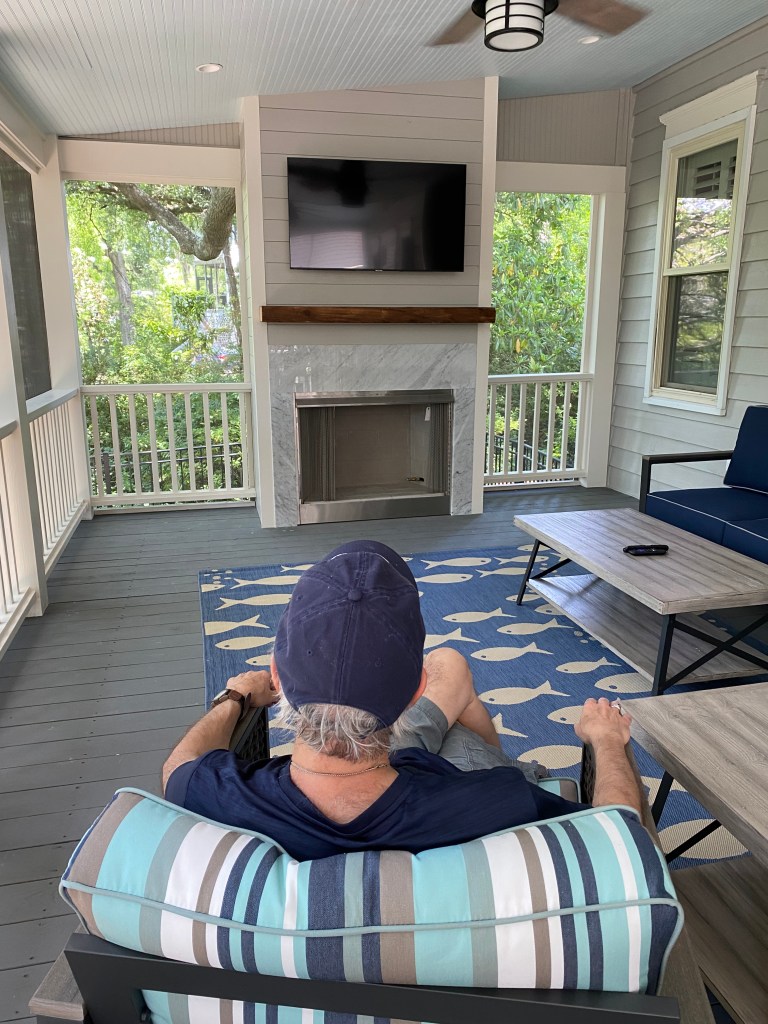
Yes, we are enjoying the porch. The design and the workmanship have been excellent. Furniture has been purchased and is in place, and we are happy with those choices. (For the curious, the indoor/outdoor rugs as well as the living room tables came from overstock.com.) But nothing has been painless, to say the least.

The greatest pain of the project surrounded construction of the fireplace, when a fireplace box was built before the fireplace insert itself was ordered. Needless to say, the insert did not fit in a way that would not burn the house down. A separate contractor was brought in to rebuild the fireplace, extend the gas line, install a water line in the porch (so we can hose down the floor during pollen season), and bring this painful part of the project to a close. Five days of labor, I was told.

Five weeks later, the work is not done. The new fireplace is built, and it is lovelier than I could have imagined with a Carrera marble surround and a barn wood mantle ordered from Etsy. Above the mantle rests a beautiful LG television set purchased from Costco (as was the dining set that seats nine). The gas line and water lines are in, and the crew members could not have been nicer. So what’s the rub?

Fortunately, it is the middle of summer, because the fireplace logs have yet to arrive. The first logs delivered came with a propane tank rather than a gas connection. For some reason — blame it on supply chain logististics — the new logs have yet to arrive.

Now you may say this is no big deal. For all intents and purposes, the porch is done. But I would have to argue with you, because no job is done until all the i’s are dotted and the t’s are crossed. And all the subcontractors paid. So there’s that unfinished part of the project.

The icing on the cake was to be the landscaping of the backyard. In all honesty, our backyard was never nice. In order to expand the deck, I removed seven terribly overgrown azaleas and for the first time, hired a landscape firm to give me a simple, workable plan for the yard. During the construction process, what was a rather ugly yard became a lumber yard and then a virtual sandpit. We really needed the help.

I was pleased with the response, the idea and the bid from a nearby landscaping firm. Selections were made for pavers (I desperately wanted a patio downstairs for the grill and some additional outdoor seating) and shrubbery (gardenias were the choice). The crew came as scheduled and worked a terrific week, until it was time to repair the sprinkler system, a standard part of their job.

The sprinkler system in the backyard was repaired, after discovering that three pipes were crushed, in all likelihood during porch construction. Zone 1 in the front yard came on. Then nothing. No other sprinkler heads emerged anywhere in the yard. No power. And the two zones that were working went dark — or dry, I should say.

And now, one week later, no one has come back to solve this mystery. So my beloved husband is in the yard, every morning and every evening, with a hose and sprinkler, protecting the investment of our new sod and shrubs.

I had delayed writing this post until the project was complete, until my astute son noted that the ever-moving goal line was the point of the post itself. The old adage regarding construction/ remodeling is true: it takes twice as long (at least) and costs twice as much (at least) as expected.

Yes, we are close, but we are not across the finish line. There are still two subcontractors with work to finish. Two subcontractors to be paid.

And one client more than anxious to get this six-week project complete, some six months later. Because those of you who know me, an avowed HGTV-addict, know I have the next project in mind!

The Accidental Friend

Far be it from me to define what makes a person a real friend, a true friend, a best friend, versus an acquaintance, or a colleague, or a Facebook friend. But as a recovering surgical patient for the past four weeks (and staring at weeks ahead), I have had ample time to reflect on what friendship means to me and to see how friendship manifests itself.

In short, I believe I will emerge from this experience not only with two magnificent hips, but with better insight into how to be a better friend to those around me. I will be there for those who have demonstrated their friendship to me — some over a lifetime, some over a matter of decades, and some for only a few years, since my return to Charleston.

Recovery is always full of surprises, so this recovery should come as no real surprise. Those who are close to me know that my greatest recovery began in late 2013, after the death of my late husband at the hands of a hit-and-run driver. That recovery is a life-long process, but it, too, brought unknown discoveries into the meaning of friendship and kindness, often at the hands of strangers (perhaps that’s the point of a different blog). I learned then that friendships come and go — some who were closest to me during the worst time of my life seem to have let me go, while others have clung to me closer than ever before. Those are true friends.

They are the friends who took me out on New Year’s Eve, even though I was the fifth wheel. They sent New York bagels and cream cheese to help me and Allan (loving husband, in-house therapist, and the epitome of what it means to be a true friend) recover from my recent surgery (a very good call). There are multiple phone calls each week, usually an hour long. That’s a friendship that started in the year 2001, and has only deepened with each passing year, despite my exit from Connecticut.

Then there are the two childhood friends with whom I have reconnected in Charleston. It is not easy to “come home” again and expect to fall back into your childhood network. I was gone for a lifetime, 45 years to be exact, and cannot expect to be suddenly welcomed into people’s lives when I have been absent for so long. But there are two women with whom I have reconnected, both childhood friends, both of whom had also left Charleston for a number of years. Their on-going contact, our lunches out, their visits, phone calls, and our shared history are a source of tremendous comfort. Those are lifelong friends, and they are golden. When we are together, the years apart disappear. Conversation is easy.

A third friend, a native Charlestonian but a lifetime New Yorker, has done a wonderful job staying in touch. She was my sole Charleston friend with whom I connected during my Connecticut-New York years. She was a part of my important lifetime events, including my 60th birthday brunch. Her mother still resides in their childhood home, so fortunately she comes to Charleston almost monthly. So I see her more often now, but the phone calls are frequent (I am her primary source for book recommendations!). That’s a real friend with a lifetime history.

And then there are the friends Allan and I have made in Charleston since moving here in 2016. In particular, we have befriended one couple through Synagogue Emanu-El and another couple at a parking garage, where we had gathered to watch July 4th fireworks (long before Covid). Coincidentally, both couples are from Ohio (there is a very large Ohio contingent in SC), so neither of them had long-entrenched friendships in Charleston, though one couple came here because their children settled here after going to the College of Charleston (a common refrain. Young people come here for the College or the Medical University of SC and never leave; hence, we have excellent health care in Charleston.) These friends have texted, called, visited, brought food — done all the things you would expect good friends to do. And we just love them!

Now this list leaves out a whole list of others. Where are the neighbors? Don’t know, except for the wonderful couple next door who brought us shrimp and grits from their restaurant. They are the best neighbors ever. Where are the phone calls or cards from cousins, nieces or nephews? And does it really matter?

Well, I have come to realize at this stage of life that little gestures mean a lot. The joy of getting a get well card would have been a real thrill. My son’s in-laws, fabulous people in California, sent me flowers! How thrilling to have flowers delivered, or edible fruit from my brother- and sister-in-law in New York! When you don’t feel well, gestures both large and small, mean the world.

I have also come to realize that the important things in life are all about quality, not quantity. But I know at this stage of life, my friends, both near and far, have their own issues — and many of them of far more important than my hip replacement.

So I don’t mean to sound cranky. Rather, I mean to sound grateful. Grateful that I am walking down this path of recovery with all kinds of friends at hand, and knowing that I will try harder to be an even better friend in the years ahead.

As I continue down my own path, which is going very well though it is not linear every day, I am so grateful for the very deep, true friends who have come into my life at every stage.

Life is good. Soon, my hips will be, too.

The Accidental Patient

At first glance, it would seem that all patients are accidental patients. No one chooses to get sick or chooses to undergo unnecessary procedures. But that is not always the case.

We have all known individuals who have had elective or cosmetic surgery to correct a perceived flaw, to enhance one’s body image, or to improve one’s self-esteem. Whatever.

In just over 48 hours, I will be a patient, but it is not by choice. For the second time in five years, I am having a hip replaced. While some would argue that this surgery is elective in nature, I would argue the opposite.

When virtually every aspect of your life is affected by a physical ailment, when your sleep is disrupted nightly, and when your natural joy is diminished (and you all know how joyous I am!), it is time to take action. In the case of my hips, I know it is time for surgery when I start fantasizing in the middle of the night about going to the kitchen and performing the surgery myself. A surgeon I am not. A surgeon I need.

It is impossible to face this kind of joint replacement surgery without some degree of trepidation. My bone is going to be sawed. My sweet, loving husband suggested we offer the orthopedist use of our electric knife that we use at Thanksgiving to carve the turkey. The hospital has assured me that they have their own tools.

In 2017, when my left hip was replaced, I spent one night in the hospital and then had six uncomfortable weeks at home. I did not bounce back the way I had hoped as quickly as I expected. But my recovery since then has been remarkable, and my left hip is beautiful. My right hip is a piece of work.

But four years and COVID-19 changes everything. My weight is lower, my body is stronger (thanks to a dedicated physical fitness routine), and a hospital stay is not on the program, if all goes well. My appointment time at the hospital is 5:30 a.m. and I hope to leave by 5:30 p.m. Overnight stays are avoided at all costs due to COVID.

At-home physical therapy is no longer prescribed, and I don’t know why. My guess is that insurance will no longer cover the cost. But in a few weeks, I will turn once again to my personal trainer who will provide my physical therapy. He is ready and eager to get me back into shape, albeit slowly.

Perhaps my greatest area of consternation is how did this happen? I have been healthy my entire life. In fact, I have never broken a bone. My only surgeries have all been related to childbirth, and I still love the kids, despite what they put me through! There really is no family history of osteoarthritis requiring joint replacement, with the exception of one first cousin who has suffered far worse than I.

So here’s my explanation: For 20 years now, since 2001 when I failed my first bone density test, I have led an active lifestyle. That lifestyle has included hundreds of miles of walks with my best friend in Connecticut, constant gym membership, numerous classes, investments in equipment, and 15 years of workouts with personal trainers.

My theory is that I simply wore out my hips. Think about the brakes of your car. After an x-number of years, they wear down and need to be replaced. I would like to think that my years of exercise, as well as years of crossing my legs on a long train commute, simply wore out my hips. They are mechanical joints that need to be replaced.

I am not sick. I am not old (maybe a late middle-ager!). But I need a few replacement parts; it can happen to the best of us. Soon I will be bionic. Watch out!

The Accidental Native

The Accidental Native is, at first glance, an obvious oxymoron. It is impossible to be an accidental native, because you are native to your place of birth.

But being a native and remaining a native are two distinct things. And so my journey begins and ends, and I am an accidental native, home again and happy to tell the story.

Upon high school graduation, I was determined to leave Charleston and never return. In the early 70s, I believed Charleston was a sleepy town with little to offer an aspiring journalist. The grass was greener in any other part of the country, and surely the temperatures were better.

Fortunately, I was also raised to believe the college years were times of exploration in many areas. Not only were you to explore academic subject matter, but you were to explore new parts of the country as well. How did you know what was out there — how did you know where you really belonged — if you never tested the waters?

Thanks to supportive parents, unafraid of multiple mortgages (I knew nothing about money, college loans, or out-of-state tuition in this days), my undergraduate and graduate years took me to UNC-Greensboro, the University of Connecticut, and the University of Missouri. My late husband’s graduate years also took us to Boston. So higher education afforded me a look at very different parts of the country.

Lo and behold, our first jobs out of school brought us back to Anderson, SC for about two years; then two years of graduate school for Tom in Boston; and then 22 years of work, life, and two children in Texas. That move still befuddles me, since we were two East Coast kids who hardly knew where Texas was on the map. Nonetheless, more years led to better jobs, bigger houses, deeper friendships, and children. Our 3-5 year planned adventure in Texas extended to 22 years.

In 2001, the opportunity presented itself to relocate to the Northeast, bringing us closer to home territory. As a family, we had 15 fabulous years in Connecticut, cut short by tragedy.

Widowed in 2013, my brother and sisters-in-law implored me to come home. Come back to Charleston, they said. Who will you call in the middle of the night when you are sick? That became a compelling argument after my first bout of severe flu and dehydration alone. “You can’t shovel sunshine,” my sister-in-law told me, time and time again, every winter.

So in 2015, I took the plunge and purchased a home in my hometown, planning to rent it out for a year and move the following year. As fate would have it, in January 2016, the stars aligned, bringing Allan into my world. That summer, he moved to Charleston with me, and we married Labor Day weekend, 2017.

So what’s it like moving back to your hometown? It’s a really big deal here.

You can live in Charleston for 50 or 60 years, but if you weren’t born here, you will forever be “from off.” So it is a great badge of honor to be able to say that you are a native.

There seem to be fewer and fewer of us here anymore. At recent synagogue and cultural events, it is hard to detect a southern accent. On the streets, nary a southern accent is to be heard.

So much has changed, as you might expect after being away for 45 years. The area of town where we live simply didn’t exist when I left. The vibrant restaurant and arts scene has exploded. And the tourism industry, once a novelty driven by the beaches, is now a 12-month business, much to the chagrin of some of the locals. There is an ongoing debate whether Charleston has lost its soul. I haven’t been here long enough (5+ years) to comment on that, but I do know the city is a lot more exciting now than it was in the early 1970s.

By any account, Charleston is a foodie’s paradise, and though real estate is red hot, the cost of living remains a fraction of what it is in other parts of the country. I put hugs and kisses on my check to the Charleston County Auditor’s Office each year when I pay my property taxes, and I can assure you I never did that in Connecticut or Texas.

It is very rare that I run into anyone from my past; I have reconnected with very few childhood friends. If they have been here through the decades, they have a full network of friends and family and are not opening their arms or networks to “newcomers.” If childhood friends are coming home again, as I did, I have a better chance of reconnecting, and that is proving true, much to my delight.

Despite that, there is a real comfort driving familiar streets and neighborhoods. Sharing with my husband what “used to be” here. Catching a memory that enters my head after 40+ years. Seeing neighborhoods that once declined now rebound. Making new friends in a town where people are just friendly.

So when someone asks me where I am from, I say with great pride that I am a native, despite my accent. It appears that my years away, particularly in the Northeast, have left me with more of that accent than a Southern accent.

Maybe I am an accidental native, brought home again by tragedy. But now I share my hometown in love. And enjoy this chapter of my life in ways I never expected.

You can go home again.

The Accidental Traveler: The Cautious Optimist

Like millions of my fellow Americans, my husband and I tiptoed back into the world of travel in recent months, when we thought — rather naively — that the worst of Covid-19 was behind us. Armed with the Moderna vaccination, we felt prepared to test the waters and re-emerge into the public.

Those who know us also know how cautious we are, particularly my husband! So our social re-entry was done in stages and with great care. It went like this:

Trip One: A road trip to St. Augustine, FL, where we stayed at an inn with only eight rooms. We knew we would not face a crowded lobby or swimming pool (though a pool would have been nice!), and we knew that we would be able to eat all of our meals outdoors. So this trip really was a safe way to begin our “global re-entry.”

The trip went off without a hitch. We enjoyed a lovely few days of sunshine, fresh air, and good food (though not as good as the food in Charleston). But we felt confident that we could negotiate the outside world in small doses.

Trip Two: The next month, emboldened by our successful Florida sojourn, we hopped a short flight to Washington, D.C., to spend Mother’s Day weekend with Allan’s daughter. Now this was a much bigger deal!

We got on a plane, fully masked, remained masked, stayed in a hotel, used Uber, and ate inside restaurants, though never felt close to other parties or unprotected. Before we sat down in the plane, we wiped our seats, the tray tables, the arm rests, and any other surface we might touch. Nonetheless, we still got on a plane.

So hurrah for us! We have successfully taken a road trip and a short plane ride. Now for the real test!

Trip Three: After canceling not one, but two, former trips to Seattle to see my son, we made reservations to go in June. Come hell or high water, I was going to go. One of the advantages of his working in Seattle — and there’s alot to love about Seattle — is the fact that there are direct flights between Charleston and Seattle. Boeing now has an enormous presence here, and its executives fly back and forth weekly. Hence, the direct flights on Alaska Air, now my favorite airline.

To sweeten the deal of this longer flight, and to use some of the miles from our canceled flights, we flew first class for the first time in our lives. I must admit it was pretty cool. We booked first class to avoid exposure — more space, less restroom contact, etc. — but we cannot deny how much we enjoyed the Alaska Air lounges and the first class treatment on board. Flying coach will never be the same, though we are about to remember the hard way.

So our trip to Seattle went smoothly. We stayed at a boutique hotel within walking distance of my son. Most of our meals were eaten outdoors. The sites were stupendous. I would go back in a heartbeat.

But as we all know, nothing stays the same. Just when we thought, as a nation, we were gaining the upper hand on Covid, the Delta variant reared its ugly head. Numbers are spiking all over the country, particularly in southern states where vaccination numbers are low and anti-vaccination sentiment runs high.

Trip Four: And it is in this scenario that we are about to board our last planned trip for the year — to a family wedding in Colorado and then on to California to see my older son and his wife. Once again, nothing is going to keep me from my children, but this trip comes with Covid trepidation.

Let’s hope when we get on the plane next week, we are still armed with all the prevention that Moderna has to offer. Stay tuned.

The Accidental Change Agent: Do As I Say, Not As I Do

Over the course of my career, particularly the last 20 years as chief marketing officer for large accounting firms, I prided myself as a change agent. My role in coming to a firm was to implement programs that would raise a firm’s public persona, improve its external and internal communications, increase the knowledge of its team members, further their professional development, and ultimately, help increase revenues to the firm. I embraced change — when it came to others.

It’s always harder at home. As the old saying goes, if something ain’t broke, don’t fix it. But things start to gnaw at you, and things repeatedly break, and then you feel it’s time for a change, even when change comes hard.

So after almost five years, I could not stand the thought of one more lengthy conversation with Xfinity/Comcast over why my cable or Internet was out. I did not want to hear one more automated phone call instructing me to tighten my cables and unplug/ replug everything. Simply put, we were spending too much money for poor service.

As I sat at my desk , I could literally see our cable exposed from its cable box for months, dragging across our neighbor’s yards, exposed to lawn mowers, foot traffic, car traffic, animals, and more. The same situation existed with other Comcast cable boxes in our neighborhood. It was time to make a break.

Several people we know were very pleased with AT&T, so we went to the local store for a look-see, with our Xfinity bill in hand. Come to find out, AT&T could provide us with the same level of television and internet service for less than half the price. We were willing to try the 14-day free trial and scheduled the in-house visit.

That visit included a technical support person, who handled the cable install, as well as a customer support person. We showed him our cell phone bill. Though we have always been pleased with Verizon, we were paying $250 a month for three lines with unlimited text and data. AT&T offered us three lines with unlimited text and data, plus three brand new iPhone 11s, for $150/ month. Bye-bye, Verizon.

In short, our monthly bills for cable, television and telephone will drop from $500 to less than $300. That is serious money over the course of a year. So far, so good with service.

But here’s my one complaint. And it is directed at all the 20- and 30-somethings who tell people of our generation that every function we need to do on our own will be easy. No worries. Click, click, click and installation will be done.

Allan and I successfully installed the AT&T television box once it arrived. The instructions were only four steps, both in pictures and words, much easier than his expert-level Lego sets. But it was not as easy to set-up the voice activated remote control. You were given the option to “skip” Google Assistant, which we did, but with no indication that skipping this step negated voice activation. Ninety minutes later, we figured that out, logged on to Google Assistant, and voice activated our remote control.

All in all, the AT&T experience was not bad. In each instance, we were able to deal with real people, who gave us phone numbers and email addresses. And theirs was an office we could visit. The young man at the AT&T even went on line and located what router we needed to buy at BestBuy, which we dutifully purchased.

If I had a complaint — and there is always something to complain about — it would be that I now have three separate accounts with AT&T: one for television service; one for internet; and one for phone. So that’s three payments to track, etc. Seems like a company that large and that smart (?) could consolidate billing…

So let’s talk about Verizon. We needed to do two functions: transfer our phones to AT&T and discontinue service. The process seemed a bit more complicated since our daughter, on our family plan, lives half a country away.

No one in the local Verizon store could help us; nor would they even let us inside the store. Literally. We were stopped at the door and referred to a 1-800 number. First, there was a 90-minute call, so long in part after remaining on hold for at least 30 minutes. The call seemed to be going well until the final step — getting a transfer pin for our daughter. Then radio silence with no call back.

After giving up on a call back, my husband called Verizon again, sat on hold for 30 minutes, and talked to a competent individual who, within 10 minutes, produced the pin number, communicated with our daughter, and the transfer was complete.

We have since learned that Verizon offers a tremendously discounted senior rate that would have reduced our monthly bill. Shame on us for never calling to inquire; shame on Verizon for not publicizing such a rate. In the end, Verizon lost a long-standing, loyal customer.

To add insult to injury, I have received multiple emails and phone calls over the past month from Comcast, notifying that it was past due time to return my Comcast equipment. That equipment was returned, in person, to a Comcast store on Dec. 11, 2020, because I was not willing to trust a shipping service prior to the holidays. One month later, Comcast still calls, looking for their equipment.

To say this process of changing our cable, internet and telephone providers was an experience from hell is an understatement. And it is an understatement because we didn’t have “live people” to talk to across a desk anymore. Someone to talk us through a process. To show us how to do things. To help us through technology. The follow-up that was promised, after the initial home visit, simply wasn’t there, for us or for our daughter.

Our generation is not a tech savvy generation. Or if it is a tech savvy generation, Allan and I missed that bus. Please don’t talk down to us and deliver on the service that you promised. All we want is to talk to a human being as we navigate our new “toys.”

I also need a new laptop. Help …

The Accidental Ridiculous Optimist

For those of you who follow me, you know that it has been quite awhile since I have posted. Call it pandemic fatigue, if you will. Perhaps it is laziness. Perhaps because I am afraid I have nothing to add to the dialogue that goes through your own head every day.

Nevertheless, here I am, at year’s end, with a message that is a blend of our Thanksgiving and holiday message. Forgive me if it is redundant to you, or will feel that way if you get our annual holiday newsletter. (Yes, we remain that dinosaur that will print and mail a hard copy newsletter this year, pandemic or not. Some habits just die hard, and it is a hard tradition to let die after 34 years.)

So here are my thoughts of the day, with thanks to Rabbi Ravski of Charleston’s Synagogue Emanu-el for introducing me to the concept of the ridiculous optimist during this year’s High Holy Days.

It would be easy to bemoan all the things we did not do during 2020. In fact, at this exact moment, Allan and I should be settling into our first-class seats headed towards a week-long birthday/ Chanukah celebration in Seattle with all of our children. But that is yet another trip this year that has been canceled.

Like most of you, since mid-March, we have turned inward and to technology, to make the most of what this year has brought. In that process, we have discovered the “ridiculous optimism” that Jim Henson brought to the Muppets and seek to find in our lives. We have so much to be grateful for in this year of 2020. For example,

  • Communication with our friends and family has increased ten-fold, whether by phone, text, FaceTime or Zoom. Maybe we all try harder to stay in touch, and that, indeed is a very good thing.
  • I have started consulting again, as a business development coach with my good friend and colleague Art Kuesel, Kuesel Consulting, one of Top 100 consultants in the public accounting field.
  • We have maintained our physical and mental health, never straying from our dedicated fitness program. Though we both miss the camaraderie of the gym, we our grateful that our home has become our gym, complete with biweekly visits from our personal trainer.
  • Our hobbies keep us busy, whether Allan’s expert-level Lego sets or my complex jigsaw puzzles, gardening, reading, or experimenting in the kitchen. I do not have the baking gene that my children do, but I have made some great pots of soup.
  • Our weekly pet therapy visits with Emma to the MUSC Shawn Jenkins Children’s Hospital came to an end in March. Volunteers are now back in the hospital, but Allan and I will not return until we can get a Covid vaccination. To fill the void of our hands-on voluntarism, which we loved, we have made a conscientious effort to be more charitable than ever, in deed (Angel Tree, food donations, school supplies, etc.), as well as monetary donations.
  • And no offense to those who feel differently, but we sighed one giant sigh of relief once votes were tallied, certified, and the transition to the Biden-Harris administration began. Even typing these words reduce my anxiety. I look forward to Monday, Dec. 14, 2020, when the electors cast their ballots.
  • In a moment of desperation, after an earlier trip was canceled, we ran away to our favorite haunt, the mountains of North Carolina, for three days, where we enjoyed cooler temps and lovely meals outdoors.

The reason we are most grateful of all, of course, is the fact that we have our health, we have each other, and our children are healthy, happy, in wonderful jobs, and in loving relations. So what more can we ask for? We hope that you, too, share our ridiculous optimism.

The Accidental(?) Optimist: I prefer my glass half-full

I would like to think that I have always been an optimist, though I have never really thought about it until the events of recent years when my optimism was put to the test. That outlook is based on the fact that I had a wonderful childhood with fabulous parents and big brothers who supported me in every way to hit those milestones throughout high school, college and graduate school that I sought.

Nor would I say that I was/am a Pollyanna. It is possible, I believe, to live with a half-glass full mentality vs. a half-glass empty mentality yet see the reality of the world around you. Sometimes, that world slaps you in the face whether you want to see it or not. Then it’s up to you to decide how to respond.

I credit much of my attitude to my late Mother, whom many would say was shy and retiring (unless she had had one drink), because she clearly played the straight guy to my outgoing Dad. But my Mom was sharp. And smart. And forward-thinking. She always worked outside of the home, in part to get away from her demanding mother-in-law or own mother, one of whom always lived with us. So my role model, for which I am eternally grateful, was that of a working mom. She always told me I could be anything I wanted to be, and thought when I first expressed interest in journalism, that I should be the next Barbara Walters. Remember, I was born in the 1950s, and women in journalism, much less network television, was breakthrough stuff. (But I chose the print media, convinced of its ability to provide a deeper look at the issues.) She also steered me away from other potential career choices that I raised, citing their instability or dependence on volunteer boards of directors for reappointments. She was one sharp woman who pointed me down the path of strength.

Over the years, I have also developed my own way of coping with issues, always looking for the right balance: Recognizing the severity, dealing with the issues, choosing the path of action, emerging with my own version of clarity. I am a firm believer that we play the largest role in creating our destiny and our own balance.

Three cases of varying magnitude come to mind that demonstrate my attitude.

The first instance occurred with the birth of my first son and my first experience with the “terrible twos.” It didn’t take me long to realize that a two-year old is simply going to behave like a two-year-old, and the only part that is terrible is how the parent responds. Once I came to that realization, our life was once again balanced. Truly, I can’t recall one period of my sons’ lives that I did not enjoy. And I worked full-time throughout my pregnancies and from the time they were six weeks old. So my plate was full, but I learned how to balance.

The second instance, and surely the most traumatic, occurred in 2013, when my husband was killed by a hit-and-run driver on a rural Connecticut road. That’s when life smacks you in the face when you least expect it. My life was turned upside down on a Sunday afternoon, and it was up to me to decide how to right that ship. What became most obvious to me instantly was that I would not do anything that would increase the pain that our sons would experience. My number one obligation was to ensure they came through this experience as unscathed as possible, though it was clearly a life-changing experience for us all. Through personal therapy at the urging of a friend, the love of family and friends, and a supportive work environment (I will forever be grateful to Berdon LLP for their kindness during this personal hell), we all made it and have moved forward. We shall never forget, or “move on,” but as I have learned from my wonderful, loving second husband, we do learn to move forward.

The third instance simply deals with the year 2020. As a nation, we have dealt with the worst turmoil and racial strife our nation has seen since the 1960s. Our government seems incapable of leadership. As a world, we are besieged by a pandemic that has brought us all to our knees. It is enough to make anyone see his/her glass as half-empty. But I refuse. Here’s how ….

From the outset of the pandemic, I refused to give up my personal training. I knew that I had to maintain my physical and mental health in order to get through this ordeal. So when the gyms closed, I brought my trainer home for twice-weekly sessions. It was the best decision made, keeping me physically and mentally fit and aware of the days of the week.

We have been cautious throughout the pandemic, but not hermits. We went to grocery stores appropriately masked and gloved, as we still do. Now we venture, cautiously, to other venues. In fact, we are about to take a three-day mini-vacation to the mountains of North Carolina for a change of scenery and a change of climate. But we are going to a very small town where we will engage with few people, be able to enjoy outside dining, and marvel at the waterfalls.

Every morning, I brew a hot cup of Peet’s coffee. As soon as I smell it and taste it, I give thanks for another day being Covid-free. My glass remains half-full.