Featured

The Accidental Remodeler: It’s a New Year. Here We Go. Again.

I am sure this comes as no surprise to those who know me. As the calendar turns to a new year, my thoughts turn to a new project for the house. In fact, my mind turns to the next project before the last project is even complete.

So here I sit, in my home office, on a beautiful spring day in March, only days before we spring forward. A paint crew, a construction crew, and a granite fabrication crew are all in the house. In other words, the factory also known as our home is a-twitter.

This year’s project is the story of how a germ of an idea, launched by my beloved daughter-in-law, turns into a project that affects the entire upstairs, including the attic. That idea? Take the second closet, a storage closet or “Christmas closet” in Dallas-speak, in the largest upstairs bedroom and convert it to a bathroom, creating an en-suite bedroom upstairs. A brilliant idea, if I must say.

Truth be told, this house needed another bath upstairs. The second story has three large bedrooms that share a jack-and-jill bath. That means we can have as many as six adults sharing one toilet, three sinks, and one tub/shower.

Rather inadequate, I think, for a large family house. My dear husband Allan is quick to note that families lived for generations with a single bathroom. I am even quicker to remind him that we no longer live in the 1950s and our children really don’t want that when they come to visit. They wholeheartedly agree!

In order to compensate for the loss of the storage closet, I floored and insulated the walk-in attic. Hung a ceiling fan. Put in an area rug. Raya has a perfect little stage to put on shows for us when she is ready. In short, our renovated attic is one cool attic now.

At the same time, I pulled the floor throughout the jack-and-jill because I disliked the choice of flooring I made when I bought the house in 2015 and raised the cabinetry 3 inches. That means I also replaced the poured clamshell countertops with natural stone, which is being installed at this moment. (To save money, ha ha, I am using the same faucets I installed when I bought the house.)

All of these shenanigans also involved closing two walls and cutting a new door to the new bathroom. And let’s not forget the small bathroom in the FROG (finished room over the garage). I am also raising that vanity and putting in the same natural stone countertop as well.

Did I mention that we are replacing a wall of windows in the kitchen — truly needed replacing — and installing a tile backsplash?

So the germ of a good idea just multiplies and leads to a series of good ideas that runs throughout the entire upstairs. And perhaps down the stairs to the kitchen. And perhaps up the back stairs to the FROG.

But my home is my castle. And there is no place else I’d rather be.

Truth be told, I’d probably never do any of this remodeling stuff if I didn’t exercise and watch so much HGTV. But that’s the subject of another post. So stick with me, please. Here’s to a healthy, happy spring….

P.S. I already have next year’s project in mind.

Featured

The Accidental Lego-Build: Not for the Faint of Heart

My husband Allan introduced me to the art of constructing jigsaw puzzles eight years ago. Together, we built a 500-piece jigsaw of garden seed packets and I was hooked. From that point on, I never built less than a 1,000-piece puzzle, and he never built another puzzle.

He, on the other hand, discovered Legos, beginning with a model of the Titanic. As a teenager, he built complex models, and Lego construction came easy to him.

So for the past eight years, I have watched him build complex Lego structures, like the Ghostbusters car, a Volkswagen camper, a London double-decker bus, a ship in a bottle, R2-D2, a Vespa, the Pope’s Fiat, the LandRover Defender, and the list goes on.

The most beautiful Lego build of all that he has done is the three-dimensional build of Van Gogh’s Starry, Starry Night, which now hangs on the wall of our family room. We are anxious to see other 3-D models come from Lego, because he is not interested in the current Spiderman model that is available. Next on his list is a revolving lighthouse, this year’s Chanukah gift.

So as I recently mentioned in a Facebook post, I thought it time I try my hand at a Lego build, having long admired some of its floral designs. Allan delivered for Chanukah, of course, because he is the near-perfect husband and would have delighted in converting me to the Lego side.

There I was, opening my little plastic bags of tiny little pieces into my puzzle sorting trays. Opening my book of instructions. Looking at those pictures as if they were drawn/ written in a foreign language.

The Lego system of building just did not come easy to me for any number of reasons:

  1. I did not find the diagrams, i.e. instructions, intuitive. At one point, I asked Allan if this model was meant for children because I found it so difficult. I felt somewhat better realizing it was designed for those 18 years and older.
  2. The pieces are incredibly small. It would be interesting to me to know if the majority of Lego builders are men or women. It would seem to be me that it would be easier for women, with smaller fingers, to manipulate these very small pieces. But I found them very difficult to handle and my nails got in the way.
  3. The pieces are hard and difficult to connect. By the end of any building session (usually 90 minutes for me), the tips of my fingers actually hurt. My hands never hurt after building a puzzle …
  4. Building a Lego is a linear process. You must attach the pieces in the precise order. If the order of operations is not followed, the build will not work. I imagine it is not unlike piecing together an engine, or an airplane, or an automobile, just on a small scale. There is little room for error. I am not a linear person, and I don’t color within the lines.

With a puzzle, if I get stumped, I simply move to “another neighborhood.” I turn my puzzle board and move to another corner. I focus on a different color. I look at things upside down or from the seat of my spin cycle. You can’t do this building a Lego model.

What I could do, however, was to build the flowers out of order. In this particular set, I thought the first flower was the most difficult (my lack of experience?) and the least attractive (definitely the color). After fighting through the first one, I realized I had to build two more! Once those three flowers were built, I flipped through the instruction book and built the flowers in the order that I chose. Imagine that!

Will I ever build another Lego set? I have learned in life to “never say never.” And a dear friend says he is passing down the bonsai garden set, another one I have admired. So who knows what will happen once I get over this initial trauma.

Allan and I have been to a Lego builder’s show where master freelancers show off their designs. They are beyond imagination! Medieval villages six feet long, complete with forests, waterfalls, and drawbridges! Colorful creatures of the forest playing symphonic instruments! Creatures of the deep crawling the ocean floor! These are built from their own imaginations and understanding of the mechanics of Lego infrastructure — these are men and women who have much more of a math, science, engineering head than I do.

They love Lego, as does my dear, sweet husband. Leave me to my puzzles, at least for the time being. And let me color outside of the lines.

Featured

The Non-Accidental Reader: Books I Read in 2023

I grew up on words. My family were/are avid crossword puzzlers and Scrabble was a mainstay in our household; I was playing against my brothers’ college friends when I was 8.

To be fair, I can’t balance a checkbook, but I was raised on words. So it should come as no surprise that I was an English major, a journalism graduate student, a newspaper reporter/owner/publisher, and a lifelong reader.

I remember not-too-fondly, as an undergraduate taking five English classes in one semester, reading five novels the night before a final. I might have fallen behind over the course of a semester because of all the time spent at the college newspaper office.

Reading was always a big part of our family’s life, as well. A holiday tradition was a trip to Barnes & Noble, where everyone would select books and we would celebrate with a fancy holiday drink. We still exchange books at the holidays. The boy’s father never turned up at a baseball game (sometimes to their chagrin) without reading material in hand. To this day, we never go anywhere without reading material in hand, though it is often on a small device, not rolled or folded under our arm.

But it wasn’t until the ripe age of 70 that I adopted this good habit from my oldest son, Zachary, who records and reports on the books he reads each year. I always find his list enjoyable, so thought I would document my list of books read this year for the first time.

This year, I read 24 books. I don’t know if that’s high or low for me, since I never tracked my reading before. But here it is, with a few notes about each.

What I will tell you is this: I discovered several new authors and a clear favorite, Geraldine Brooks. Read three of hers, but my clear favorite book of the year was People of the Book. I highly recommend anything she writes. My other favorite authors were Naomi Ragen (read three of hers), Abraham Verghese (who reappeared after a 10-year hiatus), and Rachel Kadish.

Hope this list inspires you to try some of these authors or simply to visit a bookstore. (The books are listed in the order in which I read them. I grade them on a 1-5 star system, with 5 stars being the highest mark.)

**Boys from Biloxi, John Grisham, 454 pages. How two families from the coast of Mississippi followed very different paths, a look at the Mafia of the South.

**Three Minutes in Poland, Glenn Kurtz, 394 pages. A testament to the author’s tenacity not to recreate a lost village, but to create a new village of descendants of Jews wiped out in Nasielsk, Poland. At times, a laborious read. Makes me wish I knew more of my descendant’s history.

**An Observant Wife, Naomi Ragen, 334 pages. Sequel to an An Unorthodox Marriage and not as satisfying. Paints a terrible picture of the closed Orthodox community of Boro Park, NY.

**The Plum Tree, Ann Marie Wiseman, 350 pages. A WWII story of a Christian young woman, a housekeeper, who fights to save the life of her Jewish boyfriend whose family is sent to the concentration camps.

****Jephte’s Daughter, Naomi Ragen, 443 pages. My favorite of the three Ragen books I read; much more depth than her later novels.

**Her Hidden Genius, Marie Benedict, 323 pages. The story of Rosalind Franklin, the scientist who discovered DNA but whose work was pirated by male scientists. She died early from her exposure to radiation. Benedict’s writing is never great literature, in my opinion, but I love that she champions women whose accomplishments were overlooked.

*Women Talking, Miriam Towes, 216 pages. I was anxious to read this book after after the Oscar nominations; it is the story of a group of women in a Mennonite colony who are being abused by men in their own colony. It is a tough read — largely their discussion in a hayloft. Have to wonder if the movie moved a bit faster …

**The Indigo Girl, Natasha Boyd, 367 pages. Historical fiction about Eliza Lucas Pinckney, who defied all odds and societal norms to develop a successful indigo crop in SC (literally a mile down the road from my house).

***Romantic Comedy, Curtis Sittenfeld, 300 pages. A delightful, light read (I read very few light reads) about a long distance, unlikely romance during COVID between a TV sketch writer and a musical super-star. Made you feel as if you were behind scenes at SNL and Tina Fey was the main character.

*****People of the Book, Geraldine Brooks, 365 pages. A beautifully written story that traces the people behind the famed illuminated Sarajevo Haggadah — how it came to be, how it was preserved and conserved — by those outside of the Jewish faith.

***The Dressmakers of Prospect Heights, Kitty Zeldis, 337 pages. A pleasant read about choices women were forced to make from late 19th century Russia through emigration, a lifetime of hardship in New Orleans, and ultimate redemption in New York. Ultimately, it is a story about a mother’s love for her child.

***The Only Woman in the Room, Marie Benedict, 293 pages. The untold story of Hedy Lamarr’s scientific genius and how it was ignored by the Navy in WWII because was a woman (her “Jewishness” was always hidden.) Her spread-spectrum technology was later used by military and private enterprise after the patent expired. One of the best Benedict books I’ve read.

*****The Weight of Ink, Rachel Kadish, 560 pages. A beautiful story of a 16th century Jewish woman who chose intellectualism (study, philosophy, letters) over love and marriage. One of my all-time favorite books!

***The Long Flight Home, Alan Hlad, 370 pages. Historical fiction regarding the use of homing pigeons by Britain’s Royal Air Force during WWII Who knew? A good read….

*****The Convenant of Water, Abraham Verghese, 715 pages. There’s a lot of conversation about this book, and it takes awhile to get into it, but it is well worth the effort. A beautiful family saga across multiple generations… I am not sure I love it as much as I love Cutting for Stone, Verghese’s novel of 10 years ago, but he is a masterful storyteller from the very first sentence. (He is also the Vice Chair of the Department of Medicine at the Stanford University School of Medicine.)

***The First Ladies, Marie Benedict, 370 pages. A book about the extraordinary friendship between Eleanor Roosevelt and civil rights activist Mary McLeod Bethune, this book is my favorite Benedict read to date. Featured two heroines!

*****Horse, Geraldine Brooks, 390 pages. The story of a racehorse, his enslaved keeper, a discarded painting, and an art historian woven together in a tale of “art and science, love and obsession, and our unfinished reckoning with racism.” I can’t seem to get enough of Brooks …

***Go as a River, Shelley Read, 302 pages. A lovely debut novel and an easy read. Story of love, loss, racism, family forgiveness, poverty, death, war — Virgin River in print.

*****The Measure, Nikki Erlick, 349 pages. What I love about this book is that I didn’t want to like it at all. But it turned out to be an unexpected, thoughtful, didn’t-want-to-put-it-on read. Would you want to know if you were going to live a long or short life?

***Heaven & Earth Grocery Store, James McBride, 381 pages. My favorite McBride book so far, likely because it is a Jewish story that ends in Charleston. I thought it a good read…

***The Last Flight, Julie Clark, 302 pages. An unusual read for me -a tale of two women at a crossroads in their lives. A good read, much to my surprise.

*One Man’s Wilderness: An Alaskan Odyssey, Sam Keith, 300 pages. A memoir of one man’s odyssey to build and live in the wilds of Alaska. Great reading for those who share this dream.

***Tiny Little Things, Cheryl Strayed, 387 pages. Have struggled with the TV series but thoroughly enjoyed the essays by Sugar, some of which were downright insightful. Makes me want to give the series another chance.

****March, Geraldine Brooks. 320 pages. This is the tale of March, the absent father from Little Women, who leaves his family to go to war in the fight against slavery. Another beautifully written story by Brooks that won her the Pulitzer Prize in 2006.

Closing out the year now with Boys in the Boat, the story of the crew team from the University of Washington and their quest for Olympic gold in 1936. It is a particularly personal tale since my son Shane is a professor there in the Linguistics Department. So that book will start my list for 2024.

Hope this list will be useful to you. Remember, never leave the house without reading material. Here’s to your great list of 2024!
Featured

The Accidental House of Rehab

Those of you who know me or follow this site know that I am a “serial remodeler.” I have dedicated several posts to the projects, both large and small, that I have undertaken at home. You can rest assured that those projects will continue in the months and years ahead, because that is simply who I am.

But the past seven months have given whole new meaning to the idea of “rehab” in our home. It started the day before Thanksgiving, when my sweet husband Allan suffered a minor stroke. It was a harrowing experience, but having spent his entire career in a physical rehab hospital in White Plains, NY, he followed doctor’s orders and was rehabbing beautifully.

That was the order of the day until late one rainy evening when he came in from walking the dog, Emma, and decided to remove his sneakers without sitting down or holding on to anything for support. A quick fall to the hardwood floors resulted in a broken hip. After three nights in the hospital and a hip repair — fortunately, not a total replacement — Allan was back in the rehab game.

Once again, he knows how to follow orders. In-house PT and OT were the order of the day and his progress was great. To his credit and perseverance, nine weeks after his surgery, we flew to Porto, Portugal and enjoyed a wonderful AMA Waterways river cruise through the Douro River Valley followed by three nights in Madrid.

To complicate matters, one week after Allan’s hip surgery, we launched a long-planned demolition and reconfiguration of our master bath and closet. So we were each working out of different bathrooms and our “closet” was a double hanging rod in the home office. Prior to construction, every item in the closet and bathroom had to be moved, down to the last sock and q-tip. The vast majority of our clothing was packed away in suitcases and plastic boxes, stashed all over the house.

So that brings us to late spring and a safe return from Portugal and Spain. Rehab to the house and person in full bloom; a recovery tour under our belt. Enough is enough, you say? Not quite.

One Saturday night, I noticed that Emma, our sweet beagle, was walking lamely on her rear left leg. I assumed she had bumped into something or strained a muscle, and all would be well Sunday morning.

Come Sunday morning, she was paralyzed.

The diagnosis? A ruptured disc, which was far better news than a tumor on her spine. Her surgery also resulted in a three-night hospital stay and a five-digit bill, but hats off to the staff at Charleston Veterinary Referral Center. We could not have asked for better care for her or better communication with us. (In my experience over the decades with my pets, I have often said that vets have much better “beside manner” than our own doctors.)

The financial pain of that experience was eased somewhat by our pet insurance, Petplan, which I have had as long as I have had Emma. Thanks to the detailed records supplied by Charleston Veterinary Referral Center and historic records by our own vet, West Ashley Veterinary Clinic, our claim was paid at 80 per cent.

So Emma and Allan continue to rehab. Emma’s legs are at about 50 per cent of their capacity, but she is able to walk again and can carefully navigate stairs. Allan has laid stair treads on the outdoor and indoor stairs, and we have placed runners all over the hardwood floors.

True to herself, her appetite has remained healthy throughout this ordeal!

So our house lives up to its name as a House of Rehab. In seven months, three surgeries and one major construction project. Is that enough stress for one year, which is only seven months old?

Perhaps this is the age of rehab, our new “normal” that comes with late middle-age. The age of the house. Our own age, as I stare 70 in the face and Allan tops me by a few years. Emma, at 11, is the equivalent of 77 in dog years.

All we can do is support and love each other through these stages and look forward to the good times ahead. But enough is enough for this year, even for this serial remodeler.

Featured

The Accidental(?) “Re”

As we neared the end of last year, my daughter-in-law kindly asked me if I would like her to notify our children that it was time for them to respond to their annual profiles for the family holiday newsletter. The newsletter is a time-honored Steinert-Threlkeld tradition, started by my late husband Tom at the birth of our first son, Zachary, 36 years ago. I will not be the one to end that tradition.

Life threw us a curve near the end of last year, and Zach’s wife, Jessica, once again rose to the occasion of the newsletter. This blog was prompted by an impromptu question Jessica added to everyone’s profile: Describe the past year (2022) in three words.

It’s not as easy as it sounds. My first thought was simply, “Let it be.” Then came “Farewell, good riddance.” But I thought that was rather negative, considering the year did include the birth of our precious granddaughter.

After some thought, I came up with what I thought was a rather clever and appropriate summary of the life Allan and I led in 2022: Replace, remodel, and rehab. It was true and alliterative. I liked the sound of it.

First, replace. That would be my right hip, replaced in January. Now I have a matching pair of titaniums, since my left hip was replaced in 2017.

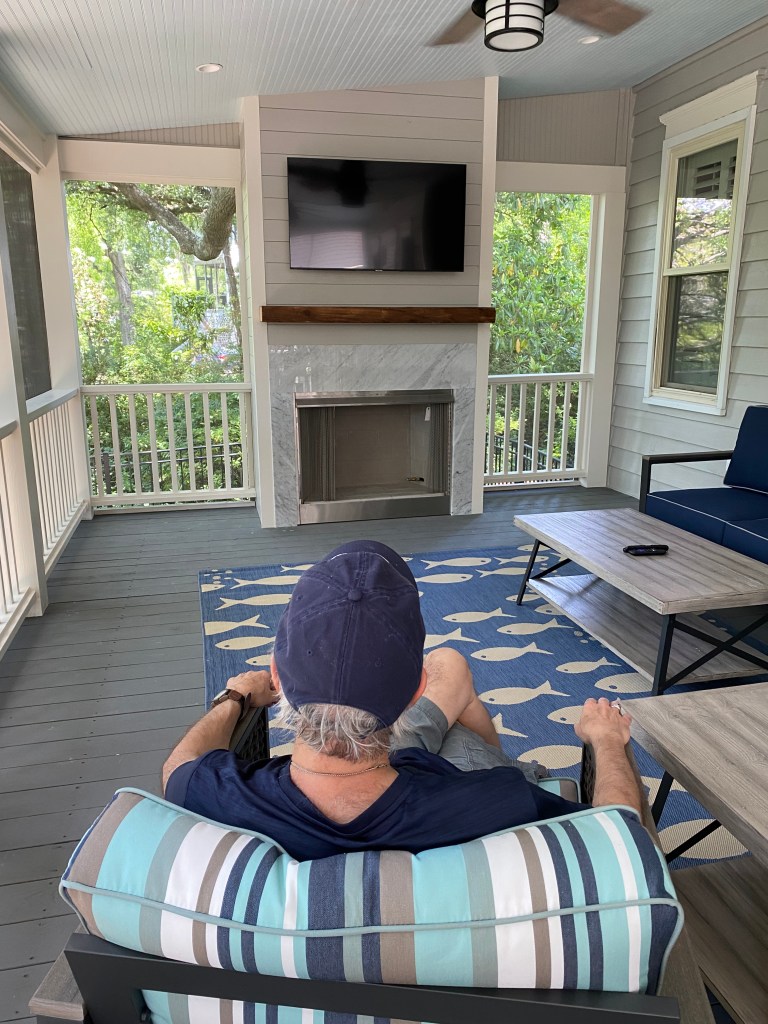
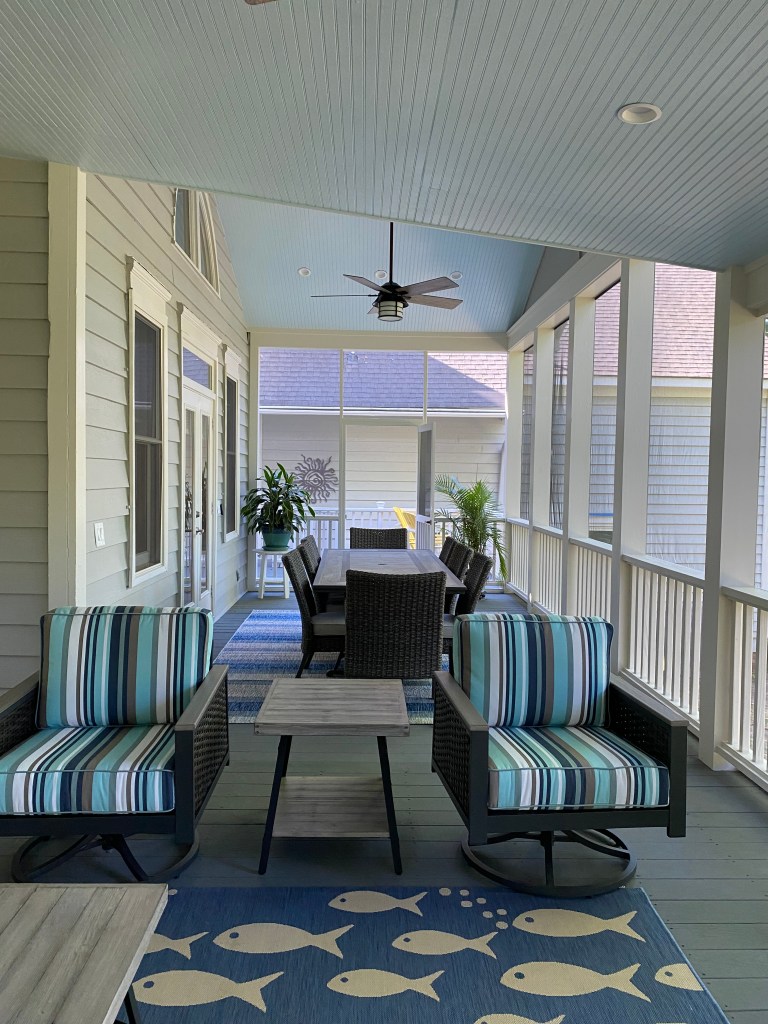
Second, remodel. That refers to the six months we spent adding a very large screened-in porch at the back of the house. This outdoor living/dining space includes recessed lighting, ceiling fans, a vaulted ceiling, a gas fireplace, and a smart TV. Despite the scheduling delays and cost overruns, we are truly enjoying this beautiful addition to the house. Maybe one day we will see an ROI; maybe we will not.

Third, rehab. This third aspect of the year is one we did not expect. The day before Thanksgiving, Allan told me he had troubled controlling the gait of his left leg. A quick visit to Roper Express revealed a sky-high blood pressure and a cursory diagnosis of a stroke, which was correct. After two nights in the hospital, Allan was discharged to rehab at home, with in-house OT and PT over the next month. We were fortunate in that he recognized the signs of what was happening; the stroke was caught early; and no lasting damage was expected. Complete recovery was the diagnosis.

So we turn the corner into 2023, full of hope, health, and travel plans. Re-solved, if you will, to have a year free of rehab and remodeling. It is not to be.

Several weeks ago, Allan fell on the hardwood floors of the foyer, only to have fractured his left hip (his side impacted by the stroke). That led to repair surgery (three screws), three nights in the hospital, and a repeat of the in-house OT and PT. Our therapists know us and our dog on a first-name basis (and that is not a claim to fame). Hence, the rehab.

And as I confessed in a blog last year, I am a serial remodeler. More inspired than ever before to remove the protruding garden tub from our master bath, to enlarge the water closet (should we need assistance), and to make the shower larger and more accessible, we are launching a complete remodel of the master bath and closet (which has bugged me for years) the first week of March. It is not a small project, and it is one that will leave us in our bedroom but will displace us from our bathroom for six weeks. Hence, the remodel.

What these experiences have shown me is that life is nothing but one great big “Re-.” We constantly re-do, remake, recycle, renew, repair, recover, redesign, all things in life. There is little that is fresh and new; in short, history, both bad and good, small and large, simply repeats itself, as it has since Adam and Eve.

Of course I made re-solutions for the New Year, that point when we re-solve to do new things or to do old things better so we won’t re-peat our same mistakes. These were my resolutions:

  1. To renew my journaling efforts, which is really a gratitude journal. It went by the wayside last year as my anxiety rose with the remodel project. I journaled early in the year until Allan got sick; I hope to start again. Interesting that I set this activity aside when I likely need it the most …
  2. To keep a list and short summary of the books I read. My son Zach keeps such a list each year and I always enjoy reading his list. So far, I have kept this resolution and am proud to say that I have finished 3 books, about 1,200 pages. You can read the list at the end of this year.
  3. To catalog my completed puzzles. Not done. First puzzle had a missing piece; second puzzle has been ignored since Allan’s hip mishap. I simply have not spent any time upstairs.
  4. To continue my health and fitness program, which I believe is now a time-honored part of my life. Unless there is a real interruption in my schedule, my program includes three workouts a week (60 minutes) with my personal trainer and two workouts (60 minutes) at home. So far, so good, except for very unusual weeks that included surgery and other minor interruptions!
  5. To travel. Thanks to Allan’s brother and his wife, who will stay with Allan while he continues to recuperate, I will make a trip to California to see the kids and my granddaughter. And, fingers crossed, Allan and I will cruise the Douro River Valley in Portugal and spend three days in Spain in April. It is that prize that helps drive his recovery. No further plans have been made, because I am rather gun-shy at this point to make further travel plans and have to reschedule.

Perhaps I should have realized long ago that life is just one big merry-go-round. We just keep making the same revolutions around the calendar as the earth revolves around the sun.

The important thing to remember is how lucky we are to keep counting those days!

Featured

The Accidental Grandmother Name: Hiding in Plain Sight

You might think it an easy thing — considering what to be called as a grandparent. I understand that there is absolute magic in the names Grandma, Grandpa, or whatever else will spill from your grandchild’s mouth, when he or she starts to recognize you and verbalize. I get that. But those who know me, and know me well, also know that I like to leave little to chance.

Most of my friends and relatives are perfectly happy, and rightfully so, to adopt the language of their culture. But in Judaism, the Yiddish word for grandmother and grandfather are Bubbe and Zayde. While rhythmic in their own right, they both bring to my mind visions of Fiddler on the Roof. And that is not me.

The Hebrew words for grandmother and grandfather are Savta and Saba. These words might be more appropriate had I grown up in a more traditional home, calling my own parents Emah and Abba (mother and father), which I did not. So these Jewish terms of endearment did not flow easily to me as well.

Then there’s simply Grandma and Grandpa. Growing up, I called my grandmothers Grandma Kirshstein and Grandma Steinert. Can you think of anything less personal or less endearing than that? I cannot, and wonder what that says about the relationships I had with my grandmothers, both of whom lived with my family during various stages of my life until I left for college. Leave that to my therapist!

Allan, of course, has no issue with his grandfather name. His father was Papa Jack to his grandchildren; and his brother is Papa Jeff to his grandchildren. All he ever wanted to be called is Papa Allan. If things only came so easily to me…

In my usual over-analytic way, I did research, looking at names used in cultures the world over for grandparents. Some were particularly lovely, but then I felt badly appropriating the language of another culture if I were not willing to use the language of my own.

In between, I fixated on created grandmother names. I like Grammy, though perhaps over-used? I had an aunt whose husband called her Honey, so everyone called her Honey, including her children and grandchildren. Another woman in town had her grandchildren call her Beautiful. No telling how my children would have reacted to that!

For awhile, I liked Khaki, repeating on the initial K from Kayte, though Zack said it reminded him of drab, casual slacks. Then I settled on Kiki. I never had a nickname as a child, and I thought Kiki sounded California cool. And Raya, a native Southern Californian, is bound to be cool, just like her Mom. But is that me? Am I really cool? Not so much …

Then pop culture came to the rescue. I doubt that many of you watched the Netflix series Shtisel about an ultra-Orthodox, Heredi family living in Jerusalem. One of the daughters was named Gitel, and her husband (a ne’er do well who redeems himself), affectionately calls her Giti. (It is a beautiful series, even in subtitles. I urge everyone to watch it, regardless of faith.)

Now I have always said that I do not have a middle name. But in truth, I was named for Kate Gitel Prodosky, the mother of my great aunt and uncle, Etta and Zeke Prodosky. Uncle Zeke and his wife, my Aunt Shirley, never had children, and regarded my brothers and me as their children. My sons, Zack and Shane, are named for them.

Though I was never fond of the name Gitel — even my sons had never heard me say it — I particularly liked Giti as a term of endearment. Upon further research, it turns out the name Gitel is a female name of Hebrew origin that means Good. I may not be California cool, but in my heart, I always try to be Good, with a capital G.

And, that to me, is a particularly fine grandmother name that lets me remain true to my heritage. Let’s hope my little Raya, when she learns to recognize me and to speak, can say it.

But if she wants to call me poopy butt-head, that will be fine, too. Though Beautiful has a nicer ring to it….

Featured

The Accidental Role Model: My Mom

Today, July 18, 2022, is a momentous occasion in my family. Had her heart not failed her in 2000, my mother, Rachel Kirshstein Steinert, would have turned 100 years old today.

Several of my friends are lucky enough to have or to have had their mothers live close to or past the century mark. My brothers and I were not that lucky, but we certainly had one great mom for 78 years.

My mom was an enigma. I daresay she would never call herself a role model. For most of her married life, either her domineering mother-in-law or her own intrusive mother lived with the family. That fact alone is enough, I believe, to prevent any woman from fully developing into her own.

But there were other factors that also “inhibited” my mother, if you will. My mother and her four siblings were poor; there is no nicer way to say it. My grandmother was widowed at a very early age, left with 5 children under the age of 15. She spoke little or no English, yet she and her two oldest children managed to maintain a semblance of her husband’s business, peddling goods around the city, keeping the books in Yiddish. In the years to come, each son turned those lessons learned into successful businesses, one in Charleston and one in Savannah. My mother was the middle sibling and the first child born in America.

The family grew up in downtown Charleston, in the shadows of the Orthodox synagogue. The three sisters and their mother shared a bed. The whole family shared one bathroom and the same bath water. Sometimes a bath was delayed if there happened to be a carp in the tub, awaiting its fateful end as gefilte fish. I tell you this story only because it sets the stage for the fact that my mother, who was smart as a whip, never had a chance to go to college.

Instead, she enrolled in a secretarial program at Charleston’s Murray Vocational School (now a beautiful condo building), so that she would be employable immediately upon graduation. And she was.

Some of my earliest memories are of going to work with her, long before “bring your child to work day” ever existed. She took me to work when she worked for the S.C. Tax Commission, which at that time was located in the Old Citadel on Marion Square. The thrill of the day for me was going to the canteen to get a Heath bar for a nickel.

Over the years, my mother held various secretarial jobs, until she eventually went to work for my father as his assistant.

Truth be told, I know my mother enjoyed working. Not only did it use her skills, but it got her out of the house and away from the nosy eyes and ears of her mother or mother-in-law. She had no thoughts what a positive role model she was providing for me. I may not have grown up baking cookies with my mom, but I got to go to work with her.

As the years went by, Mom provided valuable advice to me, even career advice when I was as young as 13. During the bat mitzvah preparatory years, I thought I wanted to become a rabbi. I was good at chanting the prayers; I liked leading services; I recognized the rabbinate as a helping profession; and knew even then it was a non-traditional role for women.

Thinking my mother would be thrilled, she immediately advised against this career path. Rabbis, she wisely told me, are hired and fired by volunteer boards of directors, and often face contract negotiations every three years. It may not provide the secure career path I thought it would be. How many times in my adult life, through memberships in various synagogues, have I thanked her for those words of wisdom.

My interests turned toward the written word in high school and college, which is no real surprise. My brothers and I were raised on Scrabble and are avid crossword puzzlers, habits learned from our parents. When I discovered in college that I may not have the skills to develop character and plot and turned towards journalism, my mother always had me aim high.

Though my inclination always leaned towards the print media — this was the era of Woodward and Bernstein — she thought I could and should be the next Barbara Walters.

There were no cell phones and Internet during our college years; I’m sure many of my friends also made the weekly phone call home on Sunday nights. But my mother wrote me every day. Many days it was only a post card, but she never wanted me to be disappointed when I opened my post office box in the dorm mail room.

She repeated a similar pattern with my children. In their very early years, she sent virtually every Berenstain Bears book to them through the mail. I have them all, waiting to read to my own grandchild. As they got a little older, she sent them baseball cards, igniting their love of the sport and sharing her love of the Atlanta Braves.

Her wisdom and encouragement never stopped. Over the years, she whispered many wise words regarding men, their behavior, and how to handle them. I think those are secrets she and I will keep, until a niece or granddaughter might need the advice. Trust me. She was always spot-on.

And all this may come as a surprise to many, because Mom always played the straight man to Dad. He was the front man, the narrator, the man on stage. She was the one behind the scenes, the “quiet one” (unless she had her one drink), perhaps the meek one.

It surprises me how much I have become my Mom; I imagine many of my girlfriends feel the same way. Sometimes, I catch myself saying things to my sons in the exact same words she used: “I only want to make things easier for you,” she would say, when she and Dad visited my family in Texas. He would defrost the freezer and she would fill it up again with brisket, spaghetti sauce, soups. I don’t cook for my kids when I visit them, but I do fill their refrigerators and freezers from Costco, which I think they like even better!

My mother’s strength was never more evident than it was after my father died. While my brothers and I expected her to crater, she did just the opposite. She took control of the house and the bills and managed all very well, embarking (as a recent blog noted) on transforming the house from masculine to feminine.

For the next 10 years, she and her youngest sister, always the best of friends, became travel buddies. They particularly liked elder hostels, which were topic-based educational trips for seniors. Often, they traveled as a pack of five, the SMART girls (the acronym represented the first initial of each name), proud of their team t-shirts. She had 10 great years after Dad died, showing us once again an inner strength we didn’t know she had.

It was that strength I drew upon when facing my own loss in 2013. Mom showed me that happiness can follow sadness, and that it is okay to be happy again.

As a mother and a new grandmother, I wonder if my mother ever knew how much she meant to me. How I appreciated the fact that she always made our house the house where everyone was welcomed. How I listened and remembered the things she said. How much I miss her nightly calls, still 22 years after her death.

She will never know what a role model she turned out to be. I only hope that I do half the job that she did.

Happy Birthday, Mom. Rest In Peace. Your memory is indeed a blessing.

Featured

The Accidental Remodeler, Part II: Are you ever really done?

Based on comments to my recent blog, it became apparent to me that the frustrations, cost overruns, contractor issues, etc. that I have experienced on my porch addition are certainly not unique. In fact, it made me feel a little better to know that so many of you have shared my pain. But that’s what friends are for, right?

What also became apparent to me, though, is that I am no accidental remodeler. If anything, I am a chronic remodeler, not only of my dwelling, but of the “stuff” of my life.

It became somewhat of a running joke in the first 35 years of my married life as to why I always had to “change my things.” Changing my things meant new dishes, new bedding, upgraded furniture, nicer jewelry — every few years. As I told my late husband, he shouldn’t worry that I “changed my things,” because I kept him. So best to keep quiet about the stuff of life.

Yet even in our first house of substance on Eagle Mountain Lake in Azle, TX, we expanded the master bedroom by taking in some attic space to create a small sitting area. That gave me room for a wingback chair, an ottoman, and a television set. That’s where I spent the wee hours of the first six months of Zack’s life nursing him during the night. We also upgraded the master bath, by sinking the tub, adding jets, and installing a skylight.

Nor did we stop there. We enclosed half of the back deck, which overlooked the lake, to create a sun porch. If memory serves me well, we failed to expand the central air-conditioning system, because I distinctly remember candles melting in that room from the heat. That room was not one of our remodeling success stories.

But the remodeling bug struck in the early 1980s.

After nine years in that house and wonderful neighborhood (still close friends with two couples from that neighborhood), we moved to a grander home in South Arlington. It was brand new and much larger, so needed no expansion, only a dash of color.

So we attempted to brighten the walls with paint. The taupe in the living room became lavender (I am not a purple person). The salmon in the bedroom became Pepto-Bismol pink. Nothing we did was quite right in that house, except for the border a friend and I installed in the boys’ bedroom: high-top sneakers with reflective soles.

The best thing we could do to correct the mistakes in that house was to sell, which we did some years later. My understanding is that the new owners painted over our mistakes immediately. Good for them!

Seems to me there were no major remodeling projects for the next four years that we lived in Cedar Hill, south of Dallas. It was a great house until the moment we knew the East Coast was calling us home.

We landed in Connecticut in 2001, moving into a center hall colonial built in 1985 (or thereabouts). It was dated in many ways and marked the start of my serious, serial remodeling. We moved kitchen cabinets, installed granite countertops, remodeled bathrooms, expanded the hardwoods, finished the basement. No room was left untouched.

And by and large, no project was a disaster. With age, comes wisdom and money. You hire better help and hopefully develop better taste.

But there was a distinct moment in time when I recognized the intrinsic value of remodeling, and it had nothing to do with increasing the value of one’s home or property. It had everything to do with one’s mental health.

In 1990, when we were in the South Arlington house, my father passed away. Though he had been diagnosed with lung cancer, the result of a lifetime of smoking, his death came suddenly and unexpectedly on Thanksgiving Day. My parents were inseparable, having been married for 49 years. Not only were they life partners, they were work partners, and my mother depended on my father for handling the affairs of their lives. My brothers and I feared for my mother — and she proved us wrong.

Our house, the only house I had ever lived in, had a strong masculine touch to it. Maybe it was the orange shag carpet in the living room. Or the exposed beams. Or the large stone bar my father had installed after he enclosed the back porch.

Mom set out to make the house her own. We watched as she packed each piece of china and every pot and pan (some she never unpacked!), had that ugly shag carpet pulled, took those beams down. Her house became girly to the nth degree.

Her walls became pink, and she didn’t seem to mind the Pepto-Bismol tones. If I remember correctly, her sofas were floral. Everything was floral. You never saw so much pink and green in your life. And whether you liked it or not, the process transformed my mother.

For months, the remodeling energized her. It gave her exercise, both physically and mentally. It allowed her to make decisions that she could enjoy and live with. Simply put, the process empowered her.

And I keenly witnessed that. The moment that I was suddenly widowed in 2013, I made a list of projects; the first projects were done out of fear. First, I installed lights up and down the long, dark driveway and doubled the flood lights all around the house. The house sat on 2.3 acres, so it was more important than ever that the house and property be as bright as possible. It became less important to me after that first electric bill came in. Suddenly, I was less scared.

I installed a chandelier in the bedroom, because I needed lightness in every room. Dark, heavy furniture gave way to brighter, colorful pieces (I was on a first-name basis at Ethan Allen), at the advice of my sister-in-law, who wisely said that every room “needs happy.” That remains my decorating mantra to this day (so I hope you like the orange coffee table in the living room, which was bought at that time).

And as the story goes, my brother and sisters-in-law finally convinced me to come home to Charleston, where I purchased a home built in 1989. It was beautifully decorated, but not to my taste, so I have spent the past five years moving from project to project. Big projects.

I have fully schooled Allan in my philosophy of “changing stuff,” but he knows I will keep him so no need to worry. He needn’t worry about my chronic need to constantly update, and in my opinion, improve my environment. What he sees as his lottery home is, in my eyes, a constant work in progress.

You heard the details of the porch project. Nothing has progressed since my last post — the sprinkler system is still not operative and the gas logs are not in the fireplace. But since we are having record-breaking heat waves, I am not too worried about those logs.

Should you be wondering, I have a list of pending projects, both small and large. I am waiting on a bid for installing some additional stair rails, two short rails into the living room and a longer banister into the FROG (finished room over the garage, our family room). Then comes the contemporary glass barn door for the laundry room.

And next year, should the market rebound and our health remain good, we will tackle the master bath and closet. That over-sized 1980s garden tub is crying to be removed and our master closet MUST be enlarged.

So I confess. I am no accidental remodeler. I am a serial remodeler. I am an avowed nester, and love improving my surroundings in small and big ways (I love art, area rugs, lamps, etc.).

Perhaps most of all, making these decisions helps me feel alive. Keeps me on top of trends and styles (most of which I ignore). There are few things in the world I can control, but I can control my own home environment. And at least in my own mind, that knowledge and the subsequent actions help me feel empowered.

Featured

The Accidental Remodeler

Or Maybe Not an Accident at all …

This post has been on my mind since January of this year, when I launched a long-awaited outdoor addition to the house. It involved removal of the back deck, expanding it across the width of the entire back of the house, roofing it, wiring it (recessed lights and ceiling fans), and screening it. The end result was to be an outdoor living room and dining room, allowing my husband and I to enjoy our beautiful lake view year-round, despite summer heat, mosquitos, or the winter chill.

It was no small project. The porch sits about eight feet above ground, so additional reinforcements needed to be built under the old porch area as well as the expanded area. Brick columns needed to be constructed that perfectly matched the existing brick columns from the former outside deck.

At the outset, during demolition (which goes rather quickly), the timeline for the project was six weeks. Well, here we are, six months later, and we have truly yet to cross the finish line.

Yes, we are enjoying the porch. The design and the workmanship have been excellent. Furniture has been purchased and is in place, and we are happy with those choices. (For the curious, the indoor/outdoor rugs as well as the living room tables came from overstock.com.) But nothing has been painless, to say the least.

The greatest pain of the project surrounded construction of the fireplace, when a fireplace box was built before the fireplace insert itself was ordered. Needless to say, the insert did not fit in a way that would not burn the house down. A separate contractor was brought in to rebuild the fireplace, extend the gas line, install a water line in the porch (so we can hose down the floor during pollen season), and bring this painful part of the project to a close. Five days of labor, I was told.

Five weeks later, the work is not done. The new fireplace is built, and it is lovelier than I could have imagined with a Carrera marble surround and a barn wood mantle ordered from Etsy. Above the mantle rests a beautiful LG television set purchased from Costco (as was the dining set that seats nine). The gas line and water lines are in, and the crew members could not have been nicer. So what’s the rub?

Fortunately, it is the middle of summer, because the fireplace logs have yet to arrive. The first logs delivered came with a propane tank rather than a gas connection. For some reason — blame it on supply chain logististics — the new logs have yet to arrive.

Now you may say this is no big deal. For all intents and purposes, the porch is done. But I would have to argue with you, because no job is done until all the i’s are dotted and the t’s are crossed. And all the subcontractors paid. So there’s that unfinished part of the project.

The icing on the cake was to be the landscaping of the backyard. In all honesty, our backyard was never nice. In order to expand the deck, I removed seven terribly overgrown azaleas and for the first time, hired a landscape firm to give me a simple, workable plan for the yard. During the construction process, what was a rather ugly yard became a lumber yard and then a virtual sandpit. We really needed the help.

I was pleased with the response, the idea and the bid from a nearby landscaping firm. Selections were made for pavers (I desperately wanted a patio downstairs for the grill and some additional outdoor seating) and shrubbery (gardenias were the choice). The crew came as scheduled and worked a terrific week, until it was time to repair the sprinkler system, a standard part of their job.

The sprinkler system in the backyard was repaired, after discovering that three pipes were crushed, in all likelihood during porch construction. Zone 1 in the front yard came on. Then nothing. No other sprinkler heads emerged anywhere in the yard. No power. And the two zones that were working went dark — or dry, I should say.

And now, one week later, no one has come back to solve this mystery. So my beloved husband is in the yard, every morning and every evening, with a hose and sprinkler, protecting the investment of our new sod and shrubs.

I had delayed writing this post until the project was complete, until my astute son noted that the ever-moving goal line was the point of the post itself. The old adage regarding construction/ remodeling is true: it takes twice as long (at least) and costs twice as much (at least) as expected.

Yes, we are close, but we are not across the finish line. There are still two subcontractors with work to finish. Two subcontractors to be paid.

And one client more than anxious to get this six-week project complete, some six months later. Because those of you who know me, an avowed HGTV-addict, know I have the next project in mind!

The Accidental Mourner

by Kayte Steinert-Threlkeld

A rather unusual topic for a blog post? Perhaps, but I want to share with you experiences my husband and I, both Jewish, recently had on an AMAWaterways river cruise along the southern Danube (Gems of SE Europe).

Several years ago in Israel, we toured Yad Vashem, the World Holocaust Remembrance Center in Jerusalem dedicated to preserving the attempted annihilation of the Jewish people by Hitler as well as to honor the estimated six million Jews who died during the Holocaust. The complex, in an understated, awesome manner, brings you up close and personal with the horrors of the Holocaust.

Yet we had a different, and perhaps even more meaningful Holocaust remembrance on our recent river cruise.

For the first time in our lives, we walked where our ancestors walked. We stood where they died. We visited synagogues, upon request and often on our own, that now serve as cultural centers or are open to tourists, but no longer function as a synagogue.

Why? There are not enough Jews left in these communities to support a synagogue as a house of worship. There are not enough Jews left in these communities to attract even an itinerant rabbi for special occasions or the High Holy Days.

Nowhere was this experience more personal than in Budapest at the Shoes on the Danube Bank memorial. This understated memorial once contained 60 pairs of shoes (originally) made of iron, of all shapes and sizes. Men and women’s shoes. Children’s shoes. The memorial was created in 2005.

At this spot on the Danube, in 1944-1945, a marker in the ground reads “To the memory of the victims shot into the Danube by Arrow Cross Militia Men in 1944-45.” It is estimated that as many as 20,000 Jews from the Budapest ghetto were taken to the riverbank and executed. Following instructions to remove their shoes (which had more value than their lives, according to the fascists), they fell into the Danube and washed out to sea, a more expedient measure than digging a mass grave. The Danube River was not the famous Blue Danube during this tragic period; the river ran red.

Sixty pairs of shoes no longer line the bank. Some were stolen in September 2014. Maybe a prank? Maybe an act of anti-Semitism? Police never investigated.

What is interesting is how visitors treat that site. Most of the shoes had rocks placed in them, a common practice for Jews as we visit a cemetery. A rock is often placed atop a headstone, to let your loved one know you have not forgotten them and came to visit.

Memorial candles were placed by some of the shoes. Several had been tied with a yellow ribbon. And the words to the Kaddish, the memorial prayer we recite to remember our loved ones, were on my lips and in my heart.

The memorial was not on our tour that day; we left our tour group, got directions, and visited on our own. During this entire trip, only one synagogue, now a cultural center restored by Unesco, was on the tour. It is located in Vidin, Bulgaria.

We saw this same scenario in Amsterdam and Prague on a prior trip. Where once Prague was home to 45,000 Jews, perhaps the Jewish community now numbers 4,500 and its synagogues are in the suburbs. The Jewish Ghetto is a must-see if you visit Prague. It is pristine, because Hitler wanted to “save” the site as a memorial to an “extinct race.”

But I digress. In Pec (pronounced Pesh), we found a beautiful synagogue now kept open by volunteers. There are only 20-30 Jews left in this village, and they try very hard to maintain the synagogue and welcome visitors. But no services are held here.

In Belgrade, Serbia, we saw a high rise being built on the site of one of the earliest concentration camp for Jews and Roma, Topovske Sure, once home to the Belgrade fairgrounds.

Only in Vidin, Bulgaria, was there a synagogue on the tour. The village touts itself as a “triangle of peace,” housing a synagogue (now a cultural center), a mosque, and a church. The synagogue, built to hold 1,000 congregants in the late 1890s, has been beautifully restored by Unesco, with renovations completed only in 2024.

According to our tour guide, Jews from Vidin and the area had been rounded up, placed in cattle cars, and were headed to the concentration camp, when the commander-in-charge halted the train, retraced its route, and freed the Jews. No one deserved to die because of their faith, he said. Bulgaria is one of the few European countries that protected its Jewish population. Hitler was so angered he bombed Vidin two more times, including a wedding with 2,000 guests. Revenge has no mercy. Very few Jews reside in Vidin today.

On our last day of the cruise (before flying to Istanbul!), we visited the tiny community of Nikopol, having no desire for a full-day tour to other sites. As we walked through this village of maybe 3,000 residents, we stumbled upon a granite monument to the strong Jewish community that was once here, as early as the 1500s (following the 1492 expulsion from Spain, Jews fanned out across Europe and Asia).

So our beautiful cruise down the South Danube was not only a cultural experience, but a religious experience as well.

We will cherish our memories and photos of those days, and pray for the growth of Jewish populations that were decimated in World War II.

Lest we forget … No.

“Yitgadal veyitkadnsh shmeh rabbah,” a transliteration of the first line of the Kaddish: Magnified and sanctified be His great name.

The Accidental Reader: Not Me! (Part 2)

Here are the remaining titles that I read in 2024. This year’s reading choices marked a real, but deliberate departure for me from earlier subject matter.

Always drawn to historical fiction, I have been pulled to books related to WWII, the Holocaust, the Resistance, and the like. There came a point where I decided I had to stay away, for at least awhile, from these hauntingly painful books. Whatever I view or read at nights goes to bed with me and fills my dreams, and I needed a break, with hopes of better sleep.

This year’s books were largely based around family dynamics. There were three authors whose names recur several times, so I can honestly say that at this moment, they are my favorite authors: Kristin Hannah, 4 books; Joyce Maynard, 4 books; and Lisa See, 3 books. Each introduced me to spectacular women, often ahead of their times, and families, whose travails brought insight into my own life, complete with its unexpected turns. On more than one occasion, the words of these authors brought me to tears.

I cite these authors and the magic of their pen (or computer) with no disrespect to others whom will always remain on my list of favorite authors: John Irving, Pat Conroy, Barbara Kingsolver, Jodi Picoult, and Abraham Verghese.

So here is the remainder of my 2024 reading list — mostly hits, with very few duds.

*Goyhood, Reuben Fenton, 275 pages. This story is a coming-of-age tale of two grown brothers as they rediscover each other and what their Judaism means to each of them. Found parts of their adventures juvenile and unbelievable. Cannot recommend and perhaps my first one-star rating ever!

*****Lady Tan’s Circle of Women, Lisa See, 395 pages. Lisa See has never disappointed me, and I think this is her best book yet! It is a historical fiction account of a famous female Chinese doctor in the 15th century. Book was beautifully written, education and insightful.

****Dear Evan Hansen, Val Emmich, et. al., 358 pages. Story is an endearing tale of lost teenage souls and their struggle to make it through high school — some do, while others do not. Looking forward to seeing this story on stage this week at Charleston’s Gailliard Auditorium.

*****The Island of Sea Women, Lisa See, 365 pages. A breath-taking (no pun intended) story of women divers, who worked and supported their families from their dry fields and wet fields (water). A close-up look at a matrifocal society in Korea and a way of life that is fading away, this book is a must-read.

***When Cicadas Cry, a debut novel by SC attorney Caroline Cleveland, 320 pages. Story revolves around an African-American man charged with killing a white woman in church. Cleveland weaves a good story of murder, unrequited love, and the meaning of family.

****Bel Canto, Ann Patchett, 318 pages. This book was a log overdue read of a beautiful story. What begins as a hostage takeover becomes a love story.

****Our Missing Hearts, Celeste Ng, 331 pages. This book is a very modern look at how society closes its eyes to gross injustice — in this instance, injustices against Asian-Americans in a Covid-stricken world. A beautiful and heart-breaking story …

****The Things We do for Love, Kristin Hannah, 464 pages. One of Hannah’s earlier words, I think this story lacks the depth of some of her later books. This story, rather predictable, is a story about motherhood and how families come together. Don’t get me wrong — the book was still a good read.

*****The Women, Kristin Hannah, 471 pages. I really delayed buying this book, for fear that it would contain gruesome accounts of warfare that would pervade my dreams. Though there were some tough battlefield scenes and detailed operating scenarios, the book is the story of the female nurses who served so valiantly in VietNam and were ignored, even by the Veteran’s Administration, upon their return home. One of the best books I have ever read!

***Life and Other Love Songs, Anissa Gray, 322 pages. Not the first time this has ever happened, but I failed to remember reading this book earlier in the year. Obviously, the book was a pleasant-enough read but apparently not memorable!

****Dreams of Joy, Lisa See, 349 pages. Though not a fan of serial or sequel books, I read this continuation of the story of Shanghai Girls, and was not disappointed. You can easily pick-up this book without reading Shanghai Girls, knowing that Lisa See is always worth reading.

****To Die For, Joyce Maynard, 241 pages. An early Maynard novel (1992), this book was a fast read and engrossing story of young love, ambition, family and murder. Delighted to have found an autographed, first edition for $5.

****Night Road, Kristin Hannah, 385 pages. Hannah gives us a close look at how the lives of one family was uprooted in one evening, after three teenagers attend a senior party, drink too much, and drive. This book takes you on an emotional roller coaster that is at times beautiful, tragic, and happy as it explores maternal love, sibling love, and young love, that sometimes is meant to last forever.

*****How the Light Gets In, Joyce Maynard, 487 pages. Once again, this book is a sequel to Count the Ways, but it is not necessary to have read Count in order to love this story. It is one of those rare books that brought tears to my eyes and a big sigh when finished.

In reviewing the books I have read this year, I try to be stingy awarding 5 stars. Those books to get that rave review from me included: Boys in the Boat, Daniel James Brown; Count the Ways and its sequel How the Light Gets In, Joyce Maynard; Magic Hour, Kristin Hannah; Circle of Women, Lisa See; The Island of Sea Women, Lisa See; and The Women, Kristin Hannah.

So some 10,500 pages later, a new stack of books awaits me, and I am excited to begin my 2025 reading. Hope you have a marvelous year of reading transformative books.

The Accidental Reader: Not Me! (Part 1)

Thanks to a more relaxed year and some long flights, 2024 was a banner reading year for me. I read 29 novels (23 last year), with three authors making multiple appearances.

Once again following the lead of my eldest son, Zachary, here is a list and brief comment about this year’s reading list; books appear in the order in which they were read. Asterisks represent stars, with five stars being the highest rating. Because of the length of this list, I will split this post into two parts. Hope you will be inspired to pick-up a few of these titles.

*****Boys in the Boat, 350 pages, Daniel James Brown. An inspiring story about the grit of the 1936 Olympic crew team from the University of Washington. Loved the movie as well, but book gave a fuller picture of these young men’s lives from childhood. Read and see.

****The Bird Hotel, 401 pages, Joyce Maynard. A beautiful read from start to finish with a surprising twist. Loved this book and Maynard’s writing.

***Life and Other Love Songs, 322 pages, Arissa Gray. Another lovely read of one man’s struggle to overcome his past, and how that affects his present and future family. A tender family story of love, loss, and redemption.

**Someone Else’s Shoes, JoJo Moyes, 435 pages. Four women are thrown together by a twist of fate form a bond that supersedes race, class, age, and other social norms. Found the book too long, at times incredulous and almost slap-stick. I was anxious to get this one done.

***Kantika, Elizabeth Graver, 282 pages. Interesting tale of one family’s displacement, focusing on the mother/wife who built a life for her family in Turkey, Spain and the US. Story is the tale of resilience of a Sephardic family, interesting to me because it is difficult to find a novel from the Sephardic point of view (versus Ashkenazi, northern European Jews of my family’s heritage).

****Resurrection Walk, a Lincoln Lawyer novel by Michael Connelly, 403 pages. A quick-reading thriller with a plot twist on every page. While not my typical genre, I thoroughly enjoyed this book, just as I enjoy the Lincoln Lawyer television series.

*****Count the Ways, Joyce Maynard, 444 pages. Novel has a slow start that turns into a sweeping saga of one family’s dissolution, tragedy, growth, and ultimate forgiveness. As with all of Maynard’s novels, in my opinion, this one once again offers up much wisdom about parenting, friendship, family and forgiveness.

****Hello Beautiful, Ann Napolitano, 387 pages A lovely story about the ties that bind four sisters (a modern-day Little Women) and the tough choices we make as parents. Very similar in theme to Count the Ways (above).

*****A Sudden Light, Garth Stein 396 pages. Another 5-star read about a family in the Pacific Northwest. Story is full of mystery, plot twists, spirituality, and naturalism (a must read for lovers of trees). I was sad when I came to the end of this novel.

**This Disaster Loves You, Richard Roper, 351 pages. Story traces one man’s quest to find his wife, who disappeared seven years earlier, by following reviews on TripAdvisor. A light, beach read that was rather predictable.

***We Are Water, Wally Lamb, 550 pages. This novel is the story of an entire family that has “come undone” in typical Lamb fashion. Found this to be an exhausting read that was at least 100 pages too long. I always considered myself a Lamb fan, because of his ties to UConn (my undergrad alma mater) and his work with female prisoners. Maybe it is time for me to be “undone” with Lamb (readers of his will understand these references).

***The Rumor Game, Thomas Mullen, 356 pages. An interesting crime-suspense-WWII story that brought to light the anti-Semitism in Boston at the outbreak of the war. Found the book enlightening and fast-paced, as told through the eyes of a Jewish reporter and an Irish FBI agent, both of whom wished they lived and met under different circumstances.

*****Magic Hour, Kristin Hannah, 391 pages. I can’t remember the last time a book brought tears to my eyes. Enough said.

***Caleb’s Crossing, Geraldine Brooks, 320 pages. Brooks’ writes beautiful novels, but this one just didn’t grip me as much as her other titles. Tale is based on the true story of a colonist’s attempts to convert Indians to Christianity, focusing on one young man, Caleb, who “crossed” from the Indian world of mythical and magical gods and cures to the Christian world of monotheism.

***Dear Edward, Ann Napolitano, 336 pages. This story is a coming of age story about a young boy who is the sole survivor of a plane crash. Found this book very difficult to read and not nearly as enjoyable as Hello Beautiful.

This concludes Part 1 of my 2024 reading list. Stay-tuned for Part 2.